
If you’ve ever admired elegant blue-and-white ceramic plates, vases, or tiles and wondered what is Delft pottery, you’re exploring one of Europe’s most fascinating ceramic traditions. Delft pottery is far more than decorative earthenware—it’s a cultural symbol shaped by global trade, artistic innovation, and centuries of skilled craftsmanship.
Originating in the Netherlands during the 17th century, Delft pottery—often called Delftware or Delft Blue—became famous for its bright white surface, hand-painted blue designs, and close resemblance to Chinese porcelain. Over time, it developed its own unique European identity and remains highly valued by collectors, designers, and art historians today.
The Birth of Delft Pottery: A Story Rooted in Global Trade
To truly understand what is Delft pottery, you must start with international trade during the Dutch Golden Age. In the early 1600s, Dutch merchants imported large quantities of Chinese blue-and-white porcelain into Europe. These porcelain pieces were admired for their thin bodies, glossy finish, and detailed artwork—but they were also expensive and fragile.
European potters wanted to recreate the look of porcelain using materials available locally. Since true porcelain required special white clay and extremely high firing temperatures unavailable in the Netherlands at the time, Dutch artisans turned to an existing technique: tin-glazed earthenware.
This method allowed potters to coat ordinary clay with an opaque white glaze, creating a smooth surface that visually resembled porcelain. Delft became the epicenter of this innovation, eventually giving its name to the pottery itself.
Why Delft Became the Center of Production
The city of Delft didn’t become famous by accident. Several factors helped it emerge as Europe’s leading tin-glazed pottery center:
- A strong economy driven by maritime trade
- Access to skilled artisans displaced from other industries
- Availability of suitable clays from surrounding regions
- A growing middle class eager for decorative household goods
By the mid-1600s, dozens of pottery workshops operated in Delft, producing tableware, decorative objects, and architectural tiles on a massive scale. These workshops refined techniques, standardized quality, and exported Delft pottery throughout Europe.
What Exactly Is Delft Pottery Made Of?
Delft pottery is technically earthenware, not porcelain. Its defining characteristics come from its glaze and decoration rather than the clay body itself.
Clay Body
- Made from a blend of local and imported clays
- Fired at lower temperatures than porcelain
- Slightly porous and softer than stoneware
Tin Glaze
- A white glaze made opaque using tin oxide
- Provides a bright, smooth painting surface
- Gives Delft pottery its signature milky white appearance
Cobalt Blue Decoration
- Painted by hand using cobalt oxide pigment
- Turns deep blue when fired
- Highly durable and resistant to fading
This combination of materials allowed Delft potters to achieve beauty and affordability without true porcelain.
The Signature Blue-and-White Style
When people picture Delft pottery, they almost always imagine blue designs on a white background. While Delftware has been produced in other colors, blue and white became its defining look.
Why Blue?
- Cobalt pigment withstands high kiln temperatures
- Inspired by Chinese porcelain aesthetics
- Creates strong visual contrast and clarity
Common Delft Motifs
- Windmills, canals, and Dutch countryside scenes
- Floral patterns and botanical designs
- Ships, harbors, and maritime themes
- Mythological and biblical scenes
- Stylized Asian landscapes and architecture
Each piece was traditionally painted freehand, meaning no two items were ever exactly alike.
Types of Delft Pottery Objects
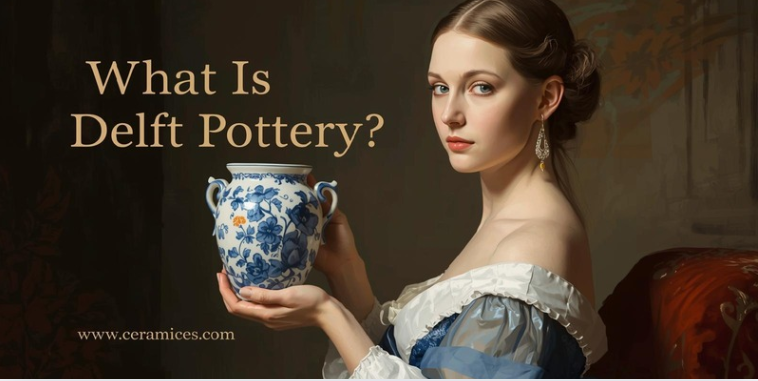
Delft pottery was not limited to decorative art. It played an active role in everyday Dutch life.
Tableware
- Plates, bowls, platters, and serving dishes
- Tea and coffee sets
- Storage jars and condiment containers
Decorative Pieces
- Vases and urns
- Figurines and ornamental objects
- Wall plaques
Delft Tiles
- Square ceramic tiles with blue designs
- Used in kitchens, fireplaces, hallways, and bathrooms
- Often depicted single images framed by corner motifs
Delft tiles were especially popular and were produced in enormous quantities, many of which still survive today.
How Traditional Delft Pottery Is Made
The production process of authentic Delft pottery is labor-intensive and requires multiple stages.
- Shaping the Clay
Clay is molded by hand or on a potter’s wheel into the desired form. - First Firing (Biscuit Firing)
The piece is fired once to harden it. - Glazing
The item is dipped into tin glaze, creating a white surface. - Hand Painting
Designs are painted directly onto the unfired glaze using cobalt pigment. - Final Firing
The glaze melts and the blue pigment becomes vivid and permanent.
Some pieces receive additional enamel colors and may undergo a third firing.
Delft Pottery vs. Porcelain
Although Delft pottery was designed to imitate porcelain, there are important differences.
| Feature | Delft Pottery | Porcelain |
|---|---|---|
| Material | Earthenware | Kaolin-based clay |
| Firing Temperature | Lower | Very high |
| Durability | More fragile | Extremely strong |
| Appearance | Opaque white | Translucent |
| Cost | More affordable | Traditionally expensive |
Understanding this distinction helps collectors and buyers know what they’re purchasing.
The Golden Age and Decline of Delft Pottery
Delft pottery reached its peak between the mid-1600s and early 1700s. During this time, it dominated European ceramic markets.
However, its decline began when:
- True porcelain production spread across Europe
- English ceramics became cheaper and more durable
- Industrial manufacturing replaced handmade methods
By the 19th century, most Delft workshops had closed, leaving only a handful still producing traditional pieces.
Modern Delft Pottery: Tradition Meets Innovation
Today, Delft pottery is still produced, though in smaller quantities. Modern artisans combine traditional hand-painting with updated designs and techniques.
Modern Delftware may include:
- Contemporary patterns alongside classic motifs
- Screen-printed designs that mimic hand painting
- Artistic reinterpretations for modern interiors
While mass-produced Delft-style ceramics exist, authentic handmade Delft pottery remains highly valued.
How to Identify Authentic Delft Pottery
If you’re shopping for Delft pottery, especially antiques, here are key indicators of authenticity:
- Visible brush strokes and slight imperfections
- Maker’s marks or factory stamps on the base
- Soft ivory-toned glaze rather than stark white
- Minor surface cracking (called crazing) on older pieces
- Yellowish clay visible at chips or worn edges
Authentic Delft pottery reflects craftsmanship—not perfection.
Why Delft Pottery Is Still Popular in the USA
In the United States, Delft pottery continues to be admired for several reasons:
- Its timeless blue-and-white color palette fits classic and modern homes
- It connects American collectors to European art history
- It works equally well as functional tableware or decorative art
- It represents handmade quality in a mass-produced world
Interior designers frequently use Delft pieces as accent items, while collectors prize antique examples for their historical significance.
Frequently Asked Questions About Delft Pottery
What is Delft pottery best known for?
Delft pottery is best known for its iconic blue-and-white designs painted on a bright white glazed surface. The style often features windmills, floral motifs, landscapes, and decorative patterns inspired by both Dutch culture and early Chinese porcelain.
Is Delft pottery the same as porcelain?
No, Delft pottery is not porcelain. Delft pottery is made from earthenware coated with a tin glaze, while porcelain is made from refined white clay and fired at much higher temperatures. Delft pottery was originally developed to imitate the appearance of porcelain using more accessible materials.
Why is most Delft pottery blue and white?
The blue color comes from cobalt pigment, which holds its color during high kiln temperatures. Blue and white also became popular because they closely resembled imported Chinese porcelain, which was highly prized in Europe during the 17th century.
Is Delft pottery still made today?
Yes, Delft pottery is still produced today, mainly in the Netherlands. Modern Delftware may be hand-painted or created using updated production methods, but traditional techniques and designs are still preserved by skilled artisans.
Is Delft pottery safe to use for food?
Modern Delft pottery made for functional use is generally safe for serving food. However, antique Delft pieces should be treated as decorative only, as older glazes may contain materials not considered food-safe by today’s standards.
How can you tell if Delft pottery is hand-painted?
Hand-painted Delft pottery usually shows slight variations in brush strokes, shading, and line thickness. When examined closely, the artwork often appears softer and less uniform than machine-printed designs.
Does Delft pottery have value?
Yes, Delft pottery can be valuable, especially antique pieces, signed works, or items from well-known historic factories. Value depends on age, condition, craftsmanship, rarity, and provenance.
Can Delft pottery be used in modern home décor?
Absolutely. Delft pottery works beautifully in both traditional and contemporary spaces. Its blue-and-white color scheme pairs well with neutral interiors, farmhouse styles, coastal themes, and modern minimalist designs.
What are Delft tiles used for?
Delft tiles were historically used for wall decoration in kitchens, fireplaces, hallways, and bathrooms. Today, they’re often used as decorative accents, backsplashes, or framed art pieces.
Is all blue-and-white pottery considered Delft?
No. While Delft pottery is blue and white, not all blue-and-white ceramics are Delft. Authentic Delft pottery originates from the Netherlands and follows specific tin-glazing and decorative traditions.
Conclusion: Why Delft Pottery Still Matters Today
Understanding what is Delft pottery means appreciating far more than beautiful ceramics. Delft pottery represents a unique moment in history when global trade, artistic ambition, and skilled craftsmanship came together to create something truly timeless. What began as an imitation of Chinese porcelain evolved into a distinctly European art form with its own identity, techniques, and cultural meaning.
Today, Delft pottery continues to captivate collectors, designers, and homeowners across the United States and beyond. Its elegant blue-and-white patterns, hand-crafted charm, and historical depth make it more than just décor—it’s a living tradition that bridges the past and present. Whether displayed on a wall, used as tableware, or collected as art, Delft pottery remains a lasting symbol of beauty, craftsmanship, and cultural exchange.
